Industrielle Anlagenverlagerung
A successful plant relocation begins long before the first dismantling step.
Through digital as-built documentation and clear structuring, dismantling, transport, and reassembly become predictable and controllable.
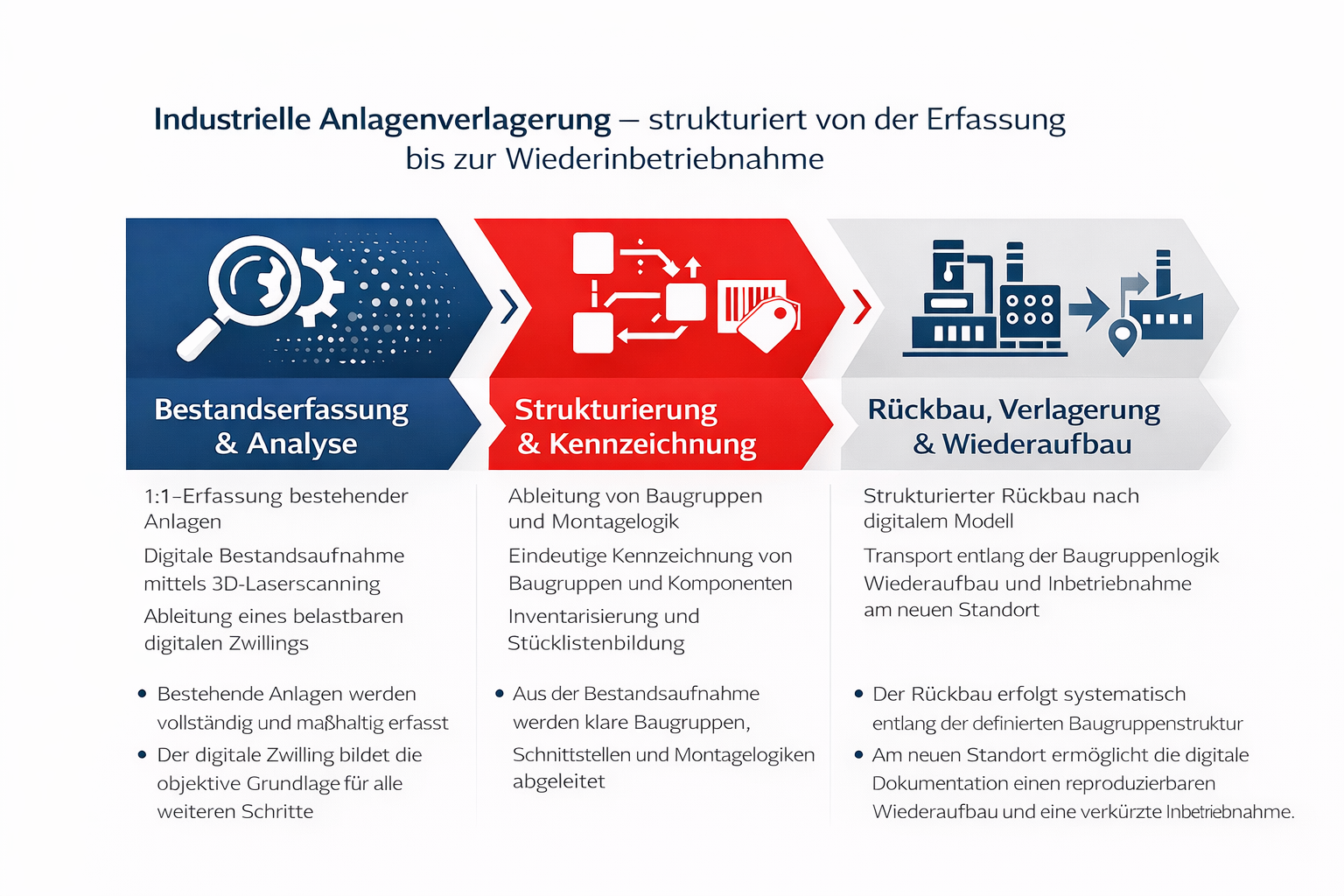
Dismantling, relocation, and reassembly using digital twin methodology
Industrial plant relocations are not merely a logistics task.
They are a technical challenge of analysis, structuring, and reconstruction.
Especially in long-established existing plants, reliable documentation, clear structures, and traceable assembly sequences are often missing.
The result is improvisation, time losses, and high downtime costs.
Our approach starts exactly here:
We capture existing plants 1:1, structure them systematically, and thereby create the foundation for controlled dismantling, safe transport, and reproducible reassembly.
Initial situation
Typical challenges in plant relocation projects:
- Incomplete or outdated as-built documentation
- Plants that have evolved and been modified repeatedly over the years
- Lack of clear assembly or modular structure
- Unclear allocation of utilities, media, and interface connections
- High dependency on individual personnel with experiential knowledge
Especially at larger industrial sites, this often leads to:
- Extended downtime periods
- Unplanned additional costs
- Conflicts between trades
- Delays in recommissioning
Our core principle
Complexity is not reduced – it is structured.
The methodology is independent of plant size.
Whether individual machines, production lines, or entire industrial sites – the approach always follows the same scheme.
Methodical approach
1. As-built capture (digital twin)
The process begins with a complete 1:1 capture of the existing plant using 3D laser scanning.
- Millimeter-accurate geometry
- Capture of machines, building structures, utilities, and foundations
- Registration into a consistent point cloud
- Supplementary photo and as-built documentation
Result:
A reliable digital twin serving as an objective basis for all subsequent steps.
2. Derivation of a structured plant model
From the digital twin, a technical model is derived that is not intended for visualization, but for dismantling and reassembly.
- Definition of machines and assemblies
- Assignment of interfaces
- Height, position, and reference definitions
- Assembly and disassembly logic
Goal:
To describe the plant in such a way that it can be reproducibly dismantled and reassembled.
3. Assembly logic & labeling
All relevant assemblies and components are systematically structured and clearly labeled.
- Clear hierarchy (Plant → Line → Machine → Assembly → Component)
- Unique identifiers
- Physical labeling on site (e.g., barcode / QR code)
- Assignment to the digital structure
Damit wird eine direkte Verbindung geschaffen zwischen:
- Physical component
- Digital model
- Assembly and transport logic
4. Inventory & documentation
Parallel to labeling, a structured inventory and bill of materials is created:
- Assembly and component description
- Dimensions, weights
- Utilities and connection information
- Special considerations for transport and assembly
These data are directly linked to the digital plant model.
5. Dismantling & transport
Dismantling is carried out in an assembly-oriented manner, not improvised.
- Clear disassembly sequence
- Transport-optimized assembly grouping
- Clear assignment during packaging and loading
- Reduced susceptibility to errors in logistics
Transport is thus based on a technical logic rather than on experiential assumptions.
6. Reassembly & commissioning
At the target site, reassembly is carried out consistently based on the prepared documentation:
- Clear position assignment
- Pre-prepared utility connections
- Traceable assembly sequence
- Reduced coordination issues between trades
The result is a shorter commissioning time and significantly higher planning reliability.
Scalability
The described approach is scalable.
The methodology remains the same –
only the scope, level of detail, and project duration vary.
- Individual machines
- Entire production lines
- Entire industrial sites
Classification
We do not view industrial plant relocations as a mere move,
but as an engineering-driven reproduction of existing systems at a new site.
This mindset creates structure – even in complex, long-established plants.


