Applied engineering development
Scherer Engineering handles application-oriented development tasks in mechanical and plant engineering when standard components or existing process solutions do not adequately meet the technical requirements.
Key areas include:
- Prototypes and functional models
- Mechanical and fluid-dynamic optimization
- Modernization and re-engineering of existing plants
- Development of machinery units and process modules
- Test operation, measurement and validation
The work combines engineering design, 3D laser scanning, digital modeling and practical testing.
Scope and definition
This page describes applied engineering development. It covers the systematic handling of specific machinery, plant and process tasks and is distinct from institutional basic research.
Typical initial situations include:
- Missing or unsuitable standard solutions
- Insufficiently understood material or flow behavior
- Unstable or insufficiently controlled processes
- Required adaptations to existing plants and confined installation spaces
- Technical uncertainties to be reduced through prototypes or tests
Development services
- Special-purpose machinery and application-specific process modules
- Mechanical components for high or variable loads
- Flow-guiding components for lightweight materials and fiber streams
- Pilot plants, functional models and test modules
- Material routes and process chains
- Transfer, size-reduction and conveying solutions
- Variant comparisons and design optimizations
Methodology
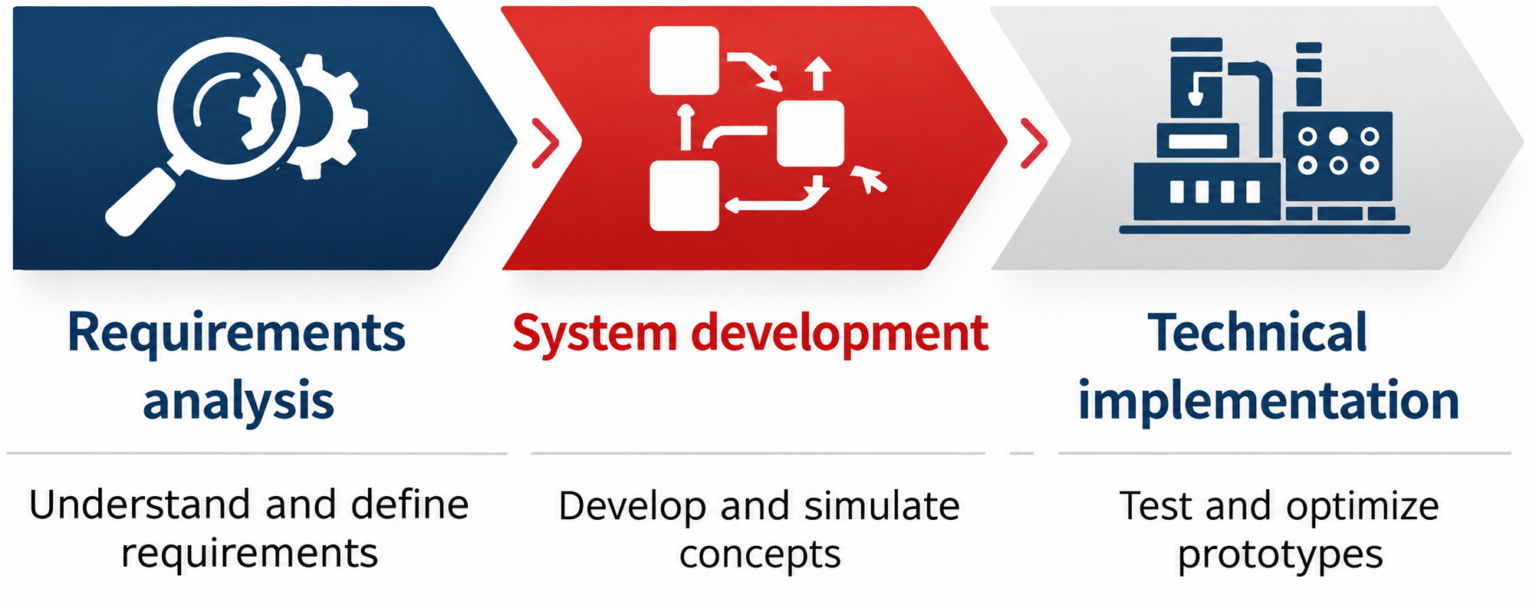
1. Technical analysis
The task, boundary conditions, as-built data and technical uncertainties are recorded and evaluated.
2. Variant and concept development
Alternative solutions are developed and compared using technical and economic criteria.
3. Engineering design and dimensioning
Geometries, assemblies, mechanisms and flow-guiding components are developed in HiCAD and HELiOS.
4. Prototypes and test units
Required functions are investigated in practice using prototypes, functional models or test units.
5. Measurement and evaluation
Relevant parameters such as forces, throughput, flow, temperature or material behavior are recorded and evaluated.
6. Iteration and validation
The results are incorporated into design adjustments and the technical verification of the selected solution.
Typical applications
- Development of a machinery unit or process module not available on the market
- Transfer of a theoretical approach into a practically testable solution
- Stabilization of processes with variable material properties
- Technical adaptation or modernization of existing plants
- Development and testing of prototypes or experimental systems
Technical focus areas
- Mechanical design and production-ready detailing
- Material, fiber and flow engineering
- Short iterations between design, testing and adjustment
- Integration into existing industrial plants
- Engineering under confined spatial and operational conditions
- Structured and reproducible project documentation
Documentation and engineering standard
Development work is documented on a project-specific and traceable basis. The scope may include:
- Version-controlled CAD models and drawings
- Design variants and decision records
- Bills of materials and technical documents in the HELiOS PDM system
- Test and measurement reports
- Image and video documentation
- Technical analyses, observations and parameter series
This keeps development statuses verifiable and usable for subsequent project phases.
Result and benefit
The objective of the development work is a technically assessed and documented solution whose function and boundary conditions can be traced through calculations, designs, measurements or tests.
The achieved maturity level is defined for each project—from a concept and functional model to an industrially deployable module.


